
For businesses searching for Web Design Stoke-on-Trent, having a professional website is no longer simply about having a place online where customers can find your contact details. A modern business website needs to communicate your brand, explain your services, build trust, work across mobile devices, and encourage visitors to take action.
Whether you operate a local shop, professional service, trades business, restaurant, start-up, manufacturer, or growing eCommerce company, your website can become one of your most valuable business assets.
Customers increasingly research businesses online before making contact. They may compare several companies, read reviews, look at services, check locations, and assess the quality of a website before deciding who to contact. This means your website needs to create a strong first impression while making the next step obvious.
For businesses in Stoke-on-Trent, choosing a web design partner with an understanding of local customers can provide an important advantage. A website can be designed around the needs of the business, its target audience, its services, and the locations it serves.
At WebFox Agency, the focus is on creating websites that combine professional design, responsive development, user experience, search-friendly foundations, and commercial objectives. The aim is to help businesses establish a stronger digital presence rather than simply producing attractive pages.
This guide explains what businesses should look for when choosing Web Design Stoke-on-Trent services and how a professionally designed website can support visibility, credibility, enquiries, and long-term growth.
Why Professional Web Design Matters for Stoke-on-Trent Businesses
A website is often one of the first places potential customers interact with your business.
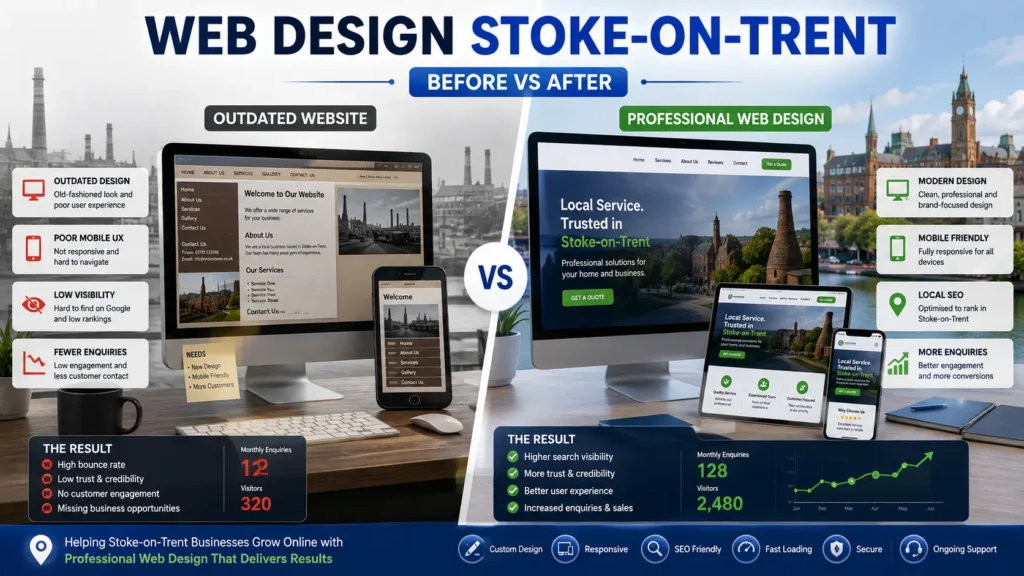
Imagine a customer searches for a local service and finds two competing companies. One website is modern, easy to navigate, mobile-friendly, and clearly explains its services. The other is difficult to use, slow, outdated, and missing important information.
Even if both businesses provide excellent services, the first website may create greater confidence.
Professional web design helps businesses communicate:
- What they offer
- Who they help
- Where they operate
- Why customers should choose them
- How customers can get in touch
A strong website also provides a platform for future digital marketing activities, including SEO, content marketing, local search optimisation, and conversion rate optimisation.
What Businesses Need From Web Design Stoke-on-Trent Services
Different businesses have different website requirements.
A local tradesperson may need a simple website focused on phone calls and quotation requests. A professional consultancy may require detailed service pages, case studies, and enquiry forms. An eCommerce business needs product pages, shopping functionality, secure checkout, and customer accounts.
A professional web design service should therefore begin with the business rather than a predetermined template.
| Business Type | Important Website Requirements |
|---|---|
| Trades business | Services, service areas, phone number, quote form |
| Professional services | Expertise, services, testimonials, enquiries |
| Retail business | Products, location, opening information, promotions |
| Restaurant | Menu, location, bookings, contact information |
| Start-up | Brand presentation, services, credibility, lead generation |
| eCommerce business | Products, categories, checkout, payments |
| B2B company | Services, case studies, industry information, enquiries |
The website should be designed according to the customer’s journey and the company’s commercial objectives.
A Website Should Be Designed Around Your Customers
One of the biggest mistakes businesses make is designing a website based entirely on what the company wants to say.
Effective web design considers what customers want to know.
A visitor may immediately ask:
What does this company do?
Can they help me?
Do they serve my area?
Can I trust them?
How do I contact them?
The website should answer these questions quickly.
For example, a local service homepage could introduce the company, explain its primary services, establish credibility, identify its service area, and provide a clear call-to-action.
This creates a more straightforward customer journey:
Search → Website → Service Information → Trust → Enquiry
Reducing unnecessary steps can make it easier for visitors to become customers.
Responsive Web Design for Mobile and Desktop Users
A modern website needs to work across different screen sizes.
Customers may discover a business using:
- Smartphones
- Tablets
- Laptops
- Desktop computers
Responsive web design ensures the website adapts to the screen being used.
Important considerations include:
- Flexible layouts
- Mobile-friendly menus
- Readable typography
- Responsive images
- Touch-friendly buttons
- Mobile-friendly forms
This is particularly important for local businesses because customers may search for a service while travelling, shopping, or looking for immediate assistance.
A mobile visitor should be able to find the company’s phone number, services, location, and enquiry options without struggling with the interface.
Local Web Design for Stoke-on-Trent Businesses
Local relevance is particularly important for companies serving Stoke-on-Trent and nearby communities.
A website can communicate local relevance through useful information about:
- Stoke-on-Trent
- Service areas
- Local customers
- Business location
- Nearby areas served
However, local optimisation should feel natural rather than forcing the location name into every sentence.
A well-structured local website might include:
Homepage → Services → Individual Service → Service Areas → Contact
This structure helps visitors understand what the business offers and where it operates.
It can also provide a useful foundation for future local SEO work.
Web Design and Local SEO Work Together
Web design and SEO should not be treated as completely separate activities.
A website needs a strong technical and structural foundation before SEO campaigns can perform effectively.
Search-friendly web design can include:
- Logical page structures
- Clear headings
- Search-friendly URLs
- Internal links
- Mobile responsiveness
- Fast-loading pages
- Descriptive image information
- Crawlable content
The design should also make important information accessible to visitors.
For example, a local business should not hide its services or contact information behind complicated navigation.
A well-designed website can therefore support both search engines and human visitors.
Website Speed Should Be Part of the Design Process
Visual design is important, but a website also needs to perform efficiently.
Large images, unnecessary animations, excessive scripts, poorly configured plugins, and inefficient code can contribute to slow loading times.
Performance-focused web design considers:
- Image optimisation
- Efficient page structures
- Lightweight design elements
- Mobile performance
- Hosting performance
- Code efficiency
A faster website provides visitors with a smoother experience.
It can also support broader SEO and conversion objectives.
This is why businesses should ask potential web design providers how performance is considered during development rather than treating speed as an issue to solve after launch.
Conversion-Focused Website Design
The purpose of many business websites is to generate an action.
That action could be:
- Calling the business
- Sending an enquiry
- Requesting a quote
- Booking an appointment
- Buying a product
- Signing up for a service
- Downloading information
Conversion-focused web design makes these actions easy to understand and complete.
Calls-to-action can include:
Request a Quote
Book a Consultation
Call Our Team
Get Started
View Our Services
The CTA should match the visitor’s stage in the buying journey.
A visitor reading a detailed service page may be ready to request a quote, while someone reading an introductory blog article may need more information first.
Building Trust Through Website Design
Customers need confidence before they choose a business.
A professional website can establish trust through:
- Customer reviews
- Testimonials
- Case studies
- Professional photography
- Business information
- Certifications where relevant
- Clear service descriptions
- Contact details
- Transparent information
Trust elements should be positioned where they support the customer’s decision.
For example, a testimonial can be valuable near a service explanation or enquiry button because it reinforces the decision at the right moment.
Clear Navigation Makes Websites Easier to Use
A beautiful website can still fail if customers cannot find information.
Navigation should be simple and logical.
A typical business website may include:
- Home
- About
- Services
- Portfolio or Case Studies
- Blog
- Contact
The exact structure should depend on the business.
For a larger website, service categories and subpages can provide additional organisation.
Good navigation helps visitors understand where they are and what they can do next.
Professional Website Design vs DIY Website Builders
DIY website builders can be useful for individuals and very simple projects. However, businesses should consider the time, technical knowledge, and strategic input required to create an effective website.
| Consideration | DIY Website | Professional Web Design |
|---|---|---|
| Design | Self-managed | Professionally planned |
| Branding | Often template-based | Tailored to business |
| UX | Owner decides | User-focused approach |
| Technical setup | Self-managed | Developer support |
| SEO foundation | Often self-configured | Can be planned from development |
| Performance | Depends on setup | Can be professionally optimised |
| Support | Platform-dependent | Agency support may be available |
| Scalability | Platform dependent | Can be planned around growth |
The right choice depends on the business’s budget, requirements, internal expertise, and growth objectives.
How Much Does Web Design Stoke-on-Trent Cost?
Website pricing varies significantly because projects have different requirements.
A simple brochure website and a complex eCommerce platform should not be expected to have the same cost.
Factors affecting web design pricing can include:
- Number of pages
- Custom design requirements
- Content creation
- Photography
- Development complexity
- CMS requirements
- eCommerce functionality
- Third-party integrations
- SEO requirements
- Ongoing maintenance
For example, a five-page local service website may require considerably less development work than an online store with hundreds of products, payment processing, customer accounts, and advanced filtering.
Businesses should therefore compare what is included rather than choosing a provider based only on the headline price.
One-Off Website Design vs Ongoing Website Service
Businesses can approach website investment in different ways.
A traditional project may involve paying for design and development upfront, followed by separate costs for hosting, maintenance, and improvements.
An ongoing website service can spread costs over time and potentially include hosting, maintenance, support, and other services depending on the agreement.
| Area | One-Off Website | Ongoing Website Service |
|---|---|---|
| Initial payment | Usually higher | Spread over time |
| Hosting | May be separate | May be included |
| Maintenance | Often separate | May be included |
| Updates | Usually charged separately | May be part of service |
| Support | Depends on provider | May be ongoing |
| Budgeting | Larger initial expense | More predictable recurring cost |
Neither approach is automatically right for every business. The best model depends on the project’s requirements and the company’s financial preferences.
Website Design for Start-Ups in Stoke-on-Trent
New businesses have unique challenges.
They need to establish credibility while keeping their initial expenses under control.
A start-up website should typically communicate:
- Business identity
- Main services
- Target customers
- Location
- Contact information
- Key benefits
- Trust signals
The initial website does not necessarily need dozens of pages.
A focused website with clear messaging can be more effective than a large website filled with unnecessary information.
As the company grows, additional service pages, blog content, case studies, landing pages, and functionality can be introduced.
Website Redesign for Established Stoke-on-Trent Businesses
Not every company needs a brand-new website.
An existing website may simply need a strategic redesign.
Signs that a website may need an update include:
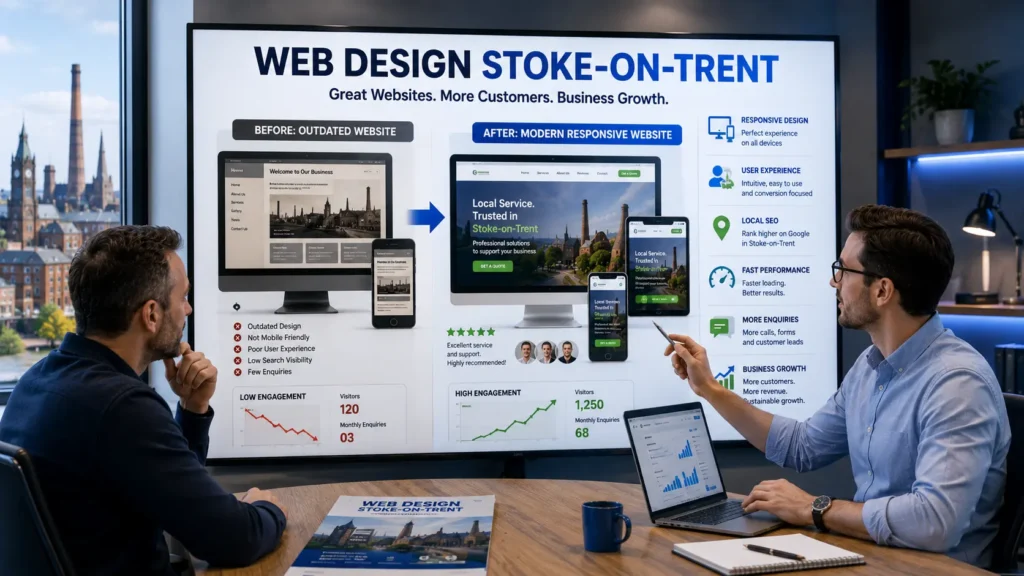
- Outdated visual design
- Poor mobile experience
- Slow performance
- Confusing navigation
- Low enquiry levels
- Difficult content management
- Weak calls-to-action
- Inconsistent branding
A redesign can improve the existing platform without abandoning everything that already works.
The process can involve reviewing:
- Existing website structure
- User behaviour
- Design problems
- Conversion opportunities
- Mobile performance
- SEO considerations
- Content organisation
This creates a more strategic approach to redesigning the website.
How UI UX Design Improves Business Websites
UI refers largely to the interface users interact with, while UX focuses on the broader experience.
Both are important for commercial websites.
Effective UI UX design can improve:
- Navigation
- Visual hierarchy
- Forms
- Buttons
- Page layouts
- Mobile interactions
- Customer journeys
For example, a service page might initially contain a large amount of text with no clear structure.
A UX-focused redesign could divide the information into:
Service Overview → Benefits → Process → Trust Signals → FAQs → CTA
This makes the content easier to scan and helps visitors understand the next step.
Web Design for eCommerce Businesses
eCommerce websites have additional requirements because the website needs to support transactions.
Important elements include:
- Product pages
- Categories
- Search
- Filtering
- Shopping cart
- Checkout
- Payment methods
- Customer accounts
- Reviews
- Mobile shopping
The customer journey needs to be as straightforward as possible.
A typical eCommerce journey looks like:
Search → Category → Product → Cart → Checkout → Purchase
If customers encounter unnecessary complexity, they may abandon the process.
Professional eCommerce web design combines attractive product presentation with usability and performance.
Website Maintenance After Launch
A website should continue receiving attention after launch.
Technology changes, software requires updates, content becomes outdated, and security threats evolve.
Ongoing website maintenance can include:
- Security updates
- Software updates
- Backups
- Performance checks
- Broken-link monitoring
- Content changes
- Technical support
Regular maintenance helps protect the investment made in the website.
It also provides opportunities to improve the website based on customer behaviour and business performance.
Measuring Whether Your Website Is Working
A website should be measured against business objectives.
Useful metrics can include:
| Metric | What It Helps Identify |
|---|---|
| Organic traffic | Search visibility |
| Enquiry volume | Lead generation |
| Conversion rate | Website effectiveness |
| Engagement | Content and UX performance |
| Mobile traffic | Importance of mobile optimisation |
| Top landing pages | Which pages attract visitors |
| Search rankings | Visibility for target terms |
For example, if a website receives 1,000 relevant visitors per month and converts 2% of them into enquiries, that produces approximately 20 enquiries.
If improvements increase the conversion rate to 3%, the same 1,000 visitors could produce approximately 30 enquiries.
This illustrates why improving the website itself can be just as important as increasing traffic.
Commercial Intent: Choosing a Web Design Service
Businesses with commercial intent are often comparing potential providers.
They may search for:
- Web Design Stoke-on-Trent
- Web design agency Stoke-on-Trent
- Website designer Stoke-on-Trent
- Professional website design
- Business website design
- Affordable web design
- Local web agency
At this stage, businesses should look beyond price.
Consider:
- Portfolio quality
- Development capabilities
- SEO knowledge
- Mobile design
- Communication
- Support
- Maintenance
- Project process
- Contract terms
The cheapest website is not necessarily the best investment if it fails to generate results or requires expensive rebuilding later.
Service Intent: Finding the Right Web Design Solution
Service-based searches indicate that users are actively looking for a specific solution.
For example, someone searching for Web Design Stoke-on-Trent may already know that they need professional website design.
A useful service page should therefore explain:
- What the service includes
- Who it is for
- How the process works
- What problems it solves
- What makes the service different
- How customers can get started
Strong service content should be informative while also making the next step easy.
Navigational Intent: Finding WebFox Agency
Some users searching for web design may already know the WebFox Agency brand.
Navigational searches could include:
- WebFox Agency
- WebFox Agency UK
- WebFox Agency Stoke-on-Trent
- WebFox Agency web design
- WebFox Agency contact
- WebFox Agency services
These users are not necessarily researching web design for the first time. They may simply want to reach the agency’s website, review its services, or make contact.
Clear website navigation is therefore important.
A simple journey could be:
WebFox Agency → Web Design → Services → Contact
Keeping important information easy to find reduces unnecessary friction for returning and brand-aware visitors.
Why Choose WebFox Agency for Web Design Stoke-on-Trent?
WebFox Agency provides a broader digital approach rather than viewing web design in isolation.
A business website can be developed with consideration for:
- Modern design
- Responsive development
- User experience
- SEO foundations
- Local visibility
- Conversion opportunities
- Website performance
- Ongoing maintenance
This connected approach is valuable because a website rarely operates alone.
Design influences user experience.
Development influences performance.
SEO influences visibility.
UX influences engagement.
Conversion optimisation influences enquiries and sales.
Maintenance protects the website over time.
Bringing these areas together can create a stronger foundation for digital growth.
Start Building a Better Online Presence
For businesses searching for Web Design Stoke-on-Trent, the right website should do more than look professional. It should communicate value, build trust, work smoothly across devices, support search visibility, and make it easy for customers to take action.
Whether you are launching a new business, replacing an outdated website, improving an existing platform, or expanding into eCommerce, professional web design can provide the foundation for your wider digital strategy.
A successful website should evolve with your business.
As your services grow, your website can expand. As customer behaviour changes, the user experience can be improved. As search visibility increases, new content and landing pages can be introduced. As your business generates more enquiries, conversion-focused improvements can help turn more visitors into customers.
For Stoke-on-Trent businesses looking for a professional digital partner, WebFox Agency can provide a combination of website design, development, SEO, eCommerce, UI UX, conversion optimisation, and ongoing website support.
The goal is simple: create a website that represents your business professionally today while giving you a strong foundation for tomorrow’s growth.