
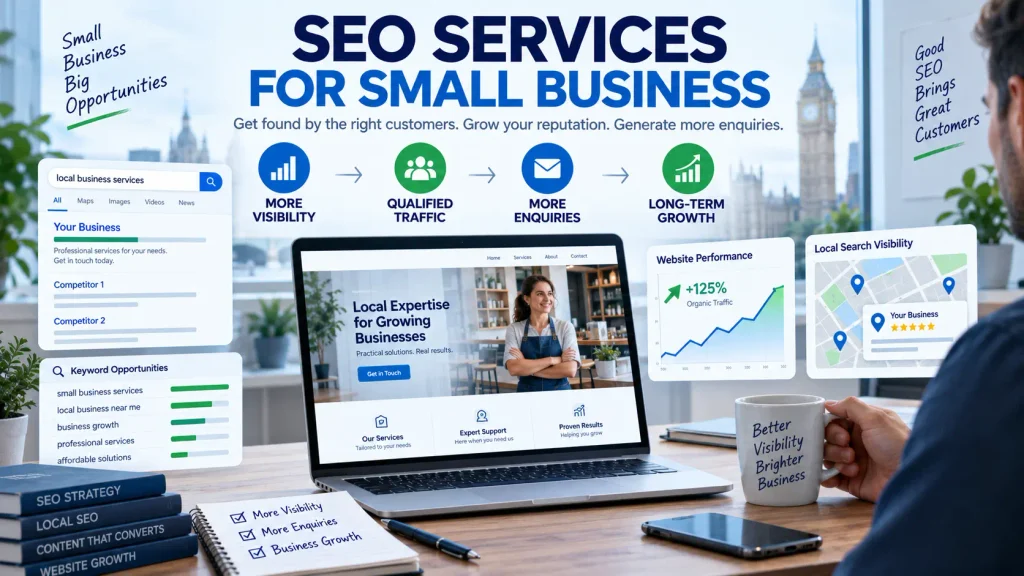
For a small business, appearing in Google when potential customers are searching for your products or services can make a significant difference to growth. SEO services for small business are designed to improve search visibility, attract relevant visitors, strengthen local presence and turn organic traffic into enquiries or sales.
The challenge is that small businesses rarely have unlimited marketing budgets. You need SEO work that is focused on commercial opportunities rather than simply generating traffic. The right SEO agency should understand your market, target the searches your customers actually make, improve your website and continually measure whether the work is contributing to business growth.
This guide explains what professional small business SEO services should include, how much different SEO activities can influence your strategy, and how to compare an SEO provider before making a decision.
What Are SEO Services for Small Business?
Small business SEO services are a combination of strategies and technical improvements designed to help a smaller company become more visible in search engines.
Unlike a one-off website optimisation project, professional SEO is normally an ongoing process. It can involve:
- Keyword research
- Search intent analysis
- On-page optimisation
- Technical SEO
- Local SEO
- Website performance improvements
- Content optimisation
- Internal linking
- Competitor research
- Google Business Profile optimisation
- Backlink analysis
- SEO reporting and performance tracking
The important point is that SEO should be connected to commercial objectives.
A plumber, solicitor, accountant, restaurant, construction company or online retailer may all need SEO, but their customers search differently. A good strategy therefore starts with the business rather than applying the same list of keywords and tactics to every website.
Why Does a Small Business Need SEO?
Customers increasingly use search engines to research businesses before making contact. If your website does not appear for relevant searches, competitors have an opportunity to capture that demand.
SEO can help a small business:
- Increase organic visibility
- Reach customers actively searching for relevant services
- Improve local search presence
- Build long-term website traffic
- Generate more enquiries
- Support online sales
- Reduce dependence on paid advertising
- Build credibility through stronger search visibility
However, more traffic alone is not necessarily the objective.
A website receiving 10,000 visitors who have no interest in the service may generate fewer enquiries than a website attracting 1,000 highly relevant visitors.
The commercial SEO equation
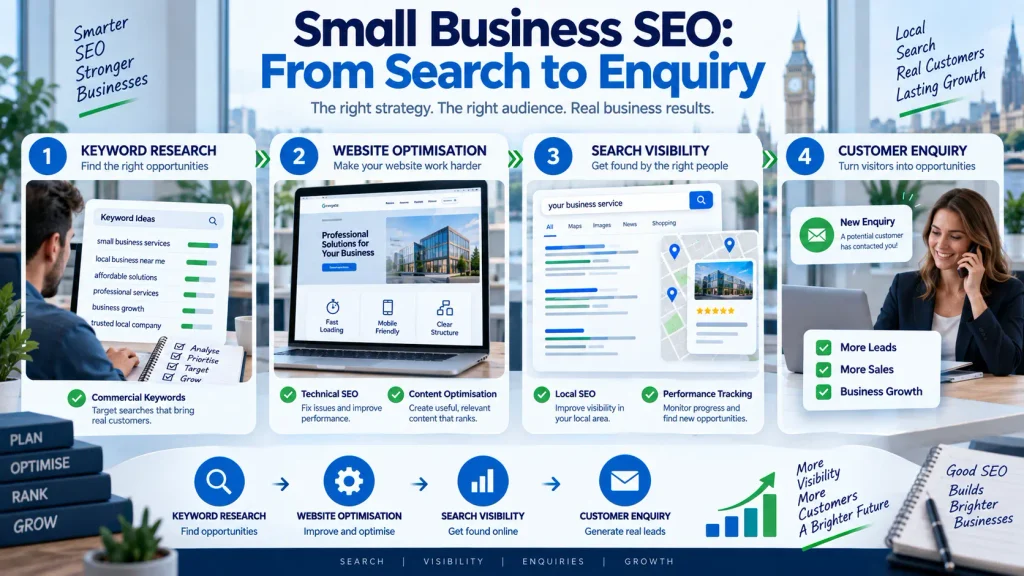
Relevant search demand → Targeted visibility → Qualified website traffic → Enquiries or sales
That is why a professional SEO service should measure more than rankings.
What Should Small Business SEO Services Include?
There is no universal SEO package that works for every company. However, a comprehensive service should normally address several important areas.
| SEO SERVICE | COMMERCIAL PURPOSE |
|---|---|
| Keyword research | Identify valuable search opportunities |
| Search intent analysis | Match pages with what customers want |
| On-page SEO | Improve relevance and page targeting |
| Technical SEO | Help search engines crawl and understand the website |
| Local SEO | Improve visibility for location-based searches |
| Content optimisation | Answer customer questions and support rankings |
| Internal linking | Connect related pages and strengthen site structure |
| Competitor analysis | Identify opportunities competitors are winning |
| Performance optimisation | Improve usability and website experience |
| Reporting | Measure progress and identify next actions |
The exact balance should depend on the condition of your website and the competitiveness of your market.
How Much Does SEO for a Small Business Cost?
SEO pricing varies considerably because businesses have different websites, industries, locations and levels of competition.
A local service business targeting one area may require a different strategy from an eCommerce company competing nationally.
Instead of choosing an SEO package purely because it is cheap, consider what work you are actually receiving for the investment.
For example, a useful way to evaluate an SEO proposal is:
| AREA | WHAT TO ASK |
|---|---|
| Strategy | What are we trying to achieve? |
| Keywords | Which commercial searches are being targeted? |
| Website | What pages need improvement? |
| Technical SEO | What technical problems will be addressed? |
| Local SEO | How will local visibility be improved? |
| Content | What content will be created or optimised? |
| Links | Is link analysis or authority building included? |
| Reporting | What will be measured each month? |
| Communication | How often will progress be discussed? |
The cheapest SEO service is not automatically the best value.
A better question is whether the service provider can clearly explain what they will do, why it matters and how success will be measured.
Small Business SEO Which Activities Should Come First?
Not every SEO task has the same priority.
A business with serious technical problems may need website improvements before investing heavily in content. Another company may have a technically strong website but lack dedicated service pages targeting valuable searches.
A practical priority framework could look like this:
| SEO PRIORITY | SUGGESTED FOCUS |
|---|---|
| Commercial keyword and search intent research | 20% |
| Website and technical improvements | 20% |
| Service and landing page optimisation | 20% |
| Local SEO and location targeting | 15% |
| Content development | 10% |
| Internal linking and site structure | 5% |
| Competitor and authority analysis | 5% |
| Reporting and continuous improvement | 5% |
| TOTAL | 100% |
This is an illustrative planning framework, not an industry-standard allocation.
The percentages are useful for thinking about priorities, not as a fixed formula. Your SEO agency should adjust the strategy based on your website, market and business objectives.
Local SEO Is Especially Important for Small Businesses
For businesses serving specific towns, cities or regions, local SEO can be one of the most commercially valuable parts of an SEO campaign.
Someone searching for:
- SEO services Birmingham
- web agency London
- accountant near me
- plumber in Manchester
- dentist in Sutton Coldfield
has already provided an important piece of information: location matters to their decision.
Local SEO can involve optimising your website, location pages, business information, Google Business Profile, local citations and other signals that help search engines understand where your business operates.
Local SEO vs General SEO
| GENERAL SEO | LOCAL SEO |
|---|---|
| Targets broader search demand | Targets location-specific demand |
| Can target national audiences | Focuses on relevant geographic areas |
| Service pages are important | Service + location relevance is important |
| Organic search results are central | Maps and local results can also matter |
| Useful for national businesses | Particularly valuable for local businesses |
For many small companies, combining both approaches creates a stronger search strategy.
Why Keyword Research Matters for Small Business SEO
One of the biggest mistakes businesses make is choosing keywords simply because they have high search volume.
High-volume keywords can be extremely competitive and may not generate the right customers.
A stronger strategy looks at commercial relevance, competition, location and search intent.
Consider the difference:
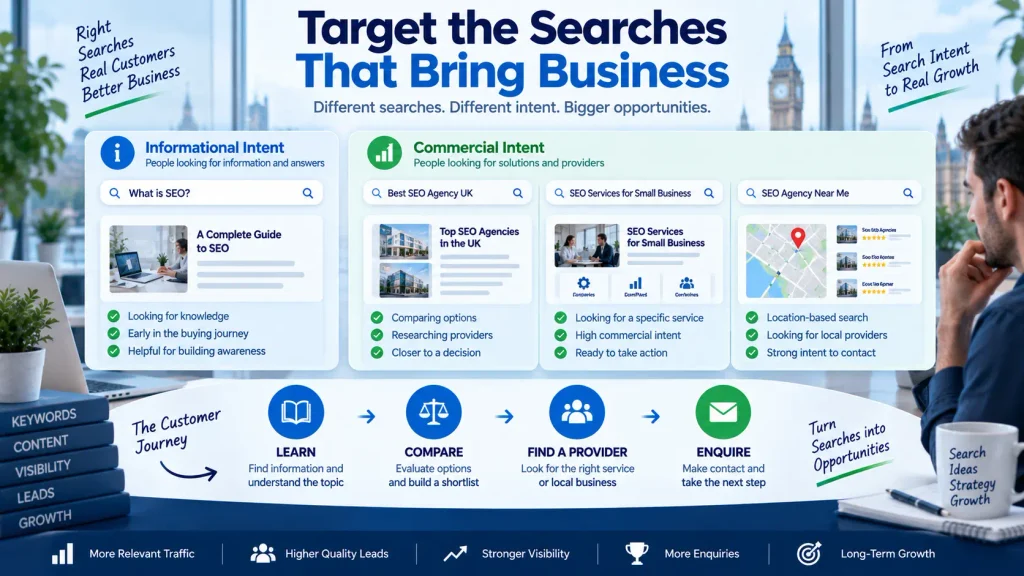
“What is SEO?”
This is primarily informational.
“SEO services for small business UK”
This is much closer to a commercial search.
“SEO agency near me”
This indicates a strong local/provider-focused intent.
This distinction matters because SEO should help your business appear when people are not only learning but also considering and choosing a provider.
Search Intent and Commercial Opportunity
Understanding search intent allows an SEO agency to connect keywords with the correct website pages.
| SEARCH INTENT | EXAMPLE | BUSINESS OPPORTUNITY |
|---|---|---|
| Informational | What is SEO? | Build awareness |
| Commercial research | Best SEO agency UK | Compare providers |
| Service-focused | SEO services for small business | Find a service |
| Local | SEO agency near me | Find a local provider |
A strong SEO strategy does not necessarily try to rank one page for every variation.
Instead, it creates a website structure where different pages satisfy different search needs.
For example:
- Homepage → broad brand and service relevance
- SEO service page → commercial SEO searches
- Small business SEO page → specific customer segment
- Local SEO page → local search demand
- Location pages → geographic searches
- Blog content → informational searches
This creates a more useful path from search → website → enquiry.
Does More Traffic Mean More Enquiries?
Not necessarily.
The commercial value of SEO depends on both the quality of traffic and the website’s ability to convert visitors.
For example, consider these simple calculations:
| MONTHLY RELEVANT VISITORS | 1% CONVERSION | 2% CONVERSION | 3% CONVERSION |
|---|---|---|---|
| 500 | 5 enquiries | 10 enquiries | 15 enquiries |
| 1,000 | 10 enquiries | 20 enquiries | 30 enquiries |
| 2,000 | 20 enquiries | 40 enquiries | 60 enquiries |
| 5,000 | 50 enquiries | 100 enquiries | 150 enquiries |
Illustrative calculations — not industry conversion benchmarks.
The calculation demonstrates why SEO and conversion optimisation should work together.
A business might benefit more from improving the quality of its existing organic traffic and website experience than simply chasing additional visitors.
SEO and Website Conversion Should Work Together
Imagine an SEO campaign successfully brings potential customers to your website, but the website:
- Loads slowly
- Looks outdated
- Is difficult to use on mobile
- Does not clearly explain the service
- Has weak calls to action
- Makes contacting the business difficult
The SEO campaign may generate visibility without producing enough commercial value.
This is why professional SEO services should consider the entire customer journey.
A simple commercial journey
SEARCH → WEBSITE → TRUST → ACTION → ENQUIRY
Every stage matters.
Your SEO agency should therefore be able to identify whether the problem is visibility, relevance, website experience, trust or conversion.
Technical SEO The Foundation of a Strong Website
Technical SEO is often overlooked by small businesses because it is less visible than content or rankings.
It can include areas such as:
- Crawlability
- Indexing
- Site architecture
- Mobile usability
- Page speed
- Core website performance
- Broken links
- Redirects
- Duplicate content
- Metadata
- Structured data
- XML sitemaps
- HTTPS and security
Technical SEO does not mean adding complicated technology for its own sake.
The objective is to make the website easier for search engines to understand and easier for customers to use.
Content SEO for Small Businesses
Content remains an important part of SEO, but creating large quantities of generic blog posts is not necessarily an effective strategy.
A better approach is to create content around real customer questions and commercial opportunities.
For example, an accounting business could create useful pages around:
- Accounting services for small businesses
- Business tax advice
- Bookkeeping services
- Payroll services
- Local accounting services
- Frequently asked questions about business accounts
The content should demonstrate expertise while naturally directing relevant visitors towards appropriate services.
Content should support the buying journey
| CUSTOMER STAGE | CONTENT TYPE |
|---|---|
| Learning | Guides and educational articles |
| Researching | Comparisons and detailed explanations |
| Evaluating | Service pages and case studies |
| Ready to act | Contact and enquiry pages |
This approach helps prevent a common SEO problem: generating informational traffic that never becomes commercially useful.
How Long Does Small Business SEO Take?
SEO is usually a long-term marketing activity rather than an instant-result service.
The timeframe depends on factors such as:
- Website age
- Existing authority
- Technical condition
- Industry competition
- Geographic targeting
- Keyword difficulty
- Content quality
- Existing search visibility
- Competitor strength
Be cautious of agencies promising guaranteed first-page rankings within an unrealistically short period.
A professional SEO provider should explain what can be improved now, what needs time, and how progress will be measured.
How to Choose the Right SEO Agency for Your Small Business
Choosing an SEO company is not simply about finding someone who knows how to optimise a website.
You need a provider that understands your commercial objectives.
Before signing an agreement, consider these questions:
1. Do they understand your industry?
An agency should take time to understand your customers, competitors, services and geographic market.
2. Do they explain their strategy clearly?
Avoid vague statements such as “we will improve your rankings.”
Ask what will actually be changed.
3. Do they target commercial keywords?
A strategy focused entirely on high-volume informational searches may not generate enough business.
4. Do they include technical SEO?
Content cannot compensate for every technical problem.
5. Do they understand local search?
If your customers are geographically concentrated, local SEO should be considered.
6. Do they provide transparent reporting?
You should understand what work has been completed and what is being improved.
7. Do they make unrealistic promises?
SEO involves competition and changing search algorithms. No reputable provider can honestly guarantee a specific Google ranking.
SEO Agency Comparison: What Should You Look For?
When comparing SEO companies, a structured evaluation can make the decision easier.
| FACTOR | BASIC SEO PROVIDER | STRATEGIC SEO PARTNER |
|---|---|---|
| Keyword research | Basic keyword list | Commercial intent analysis |
| Website review | Limited checks | Technical and UX review |
| Content | Generic publishing | Search-focused content strategy |
| Local SEO | Optional | Integrated where relevant |
| Competitor analysis | Limited | Ongoing opportunity analysis |
| Reporting | Rankings only | Visibility, traffic and commercial metrics |
| Strategy | Fixed package | Business-specific |
| Support | Task-based | Ongoing consultation and optimisation |
This does not mean every small business needs the most expensive agency available.
It means you should compare the quality and relevance of the service, not just the monthly price.
Why Choose WebFox Agency for Small Business SEO?
WebFox Agency provides SEO and digital services designed to help businesses improve their online presence and search visibility.
Our approach combines SEO with the website itself, because strong search performance is more valuable when visitors have a clear path towards becoming customers.
SEO support can include:
- Keyword research
- On-page SEO
- Technical SEO
- Content optimisation
- Local SEO
- Website speed optimisation
- SEO audits
- Competitor analysis
- Internal linking
- Performance tracking
- Ongoing optimisation
For businesses that need both website and SEO improvements, combining these services can create a more consistent digital strategy rather than treating search visibility and website development as separate projects.
The goal is straightforward: help the right people find your business and give them a better reason to contact you.
What Should a Small Business Ask Before Buying SEO Services?
Before choosing an SEO agency, ask for clear answers to these questions:
- What SEO problems does my website currently have?
- Which keywords represent the strongest commercial opportunities?
- Who are my main search competitors?
- Will you optimise existing pages or create new ones?
- Is local SEO included?
- What technical SEO work is included?
- How will content be handled?
- What will you report each month?
- Who owns the website and SEO assets?
- How will we measure business outcomes?
- What happens if we stop the service?
- Are you guaranteeing rankings?
The answers can reveal whether you are buying a genuine SEO strategy or simply a collection of monthly tasks.
FAQs About SEO Services for Small Business
How much do SEO services for small business cost?
There is no single price because SEO requirements vary by industry, competition, website condition and target market. A professional provider should assess your website and business objectives before recommending the appropriate level of SEO support.
Is SEO worth it for a small business?
SEO can be valuable when your potential customers actively use search engines to find products or services. The strongest campaigns focus on relevant commercial searches rather than traffic volume alone.
Can a small business compete with larger companies on Google?
Yes. Smaller businesses can compete by targeting specific services, locations, customer needs and long-tail searches rather than attempting to compete for every broad keyword.
How long does SEO take to work?
Results vary depending on competition, website authority, technical condition and the amount of optimisation being implemented. SEO should generally be viewed as an ongoing growth strategy rather than a guaranteed short-term campaign.
Should a small business use local SEO?
If your company serves customers in specific locations, local SEO can be particularly important. It can help improve visibility for location-based searches and support local customer acquisition.
What is included in small business SEO?
Depending on the provider, services can include keyword research, on-page optimisation, technical SEO, content optimisation, local SEO, competitor analysis, website performance improvements and reporting.
Can SEO generate leads?
Yes, SEO can contribute to lead generation by attracting people searching for relevant products or services. However, lead generation also depends on the quality of the traffic and how effectively the website converts visitors into enquiries.
Should I choose cheap SEO services?
Price should not be the only consideration. Extremely low-cost SEO may provide limited strategy or optimisation. Compare the actual work, communication, reporting and commercial focus before making a decision.
Can I do SEO myself?
Basic SEO can be managed internally, particularly for smaller websites. However, technical SEO, competitive keyword research, content strategy and ongoing optimisation can become time-consuming. An experienced SEO agency can provide specialist knowledge and a structured process.
Does WebFox Agency provide SEO services for small businesses?
Yes. WebFox Agency provides SEO and digital services for businesses looking to improve search visibility, website performance and online growth.
Conclusion: Invest in SEO That Supports Business Growth
The best SEO services for small business are not simply about getting more keywords onto a website or producing a larger number of blog posts.
Effective SEO connects search visibility with commercial intent.
Your strategy should identify the searches that matter, improve the website experience, strengthen technical foundations, target relevant locations and continuously measure what is contributing to business opportunities.
If your small business wants more than rankings and needs a website and SEO strategy designed around genuine customer acquisition, choosing the right SEO partner can be one of the most important digital marketing decisions you make.