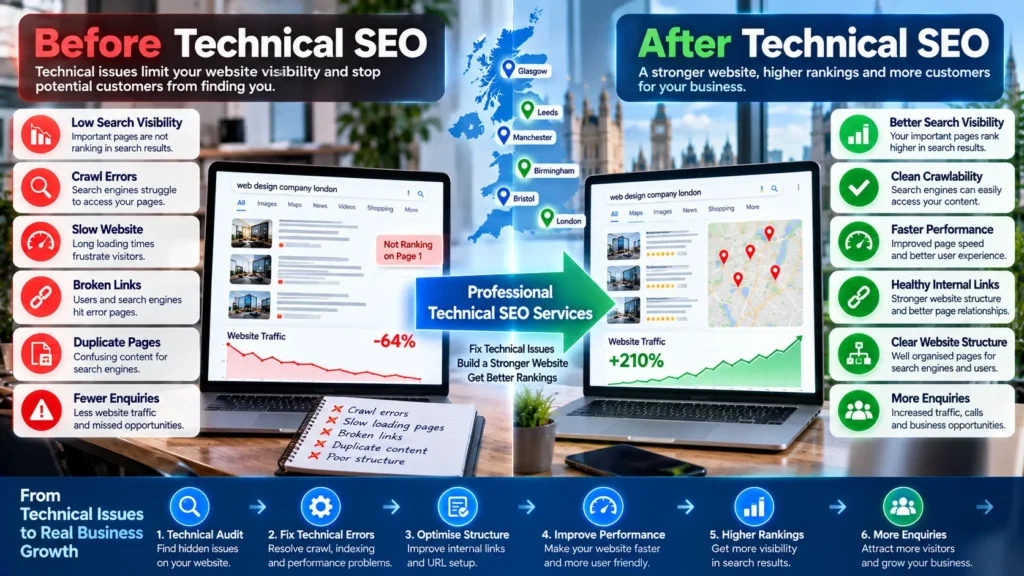
Your website can have great content and strong services yet still struggle to appear in Google when technical problems prevent search engines from properly crawling understanding or indexing your pages. This is where technical SEO services become valuable. Instead of adding more content to a website that already has unresolved technical problems a professional technical SEO strategy identifies what is blocking organic visibility and fixes the foundations that support search performance.
For UK businesses this can make a major difference.
A service page that cannot be crawled is difficult to discover. A product page with the wrong canonical signal can create indexing problems. A slow mobile experience can frustrate visitors. Broken internal links can weaken website structure. Duplicate pages can make it harder for search engines to understand which version matters.
Technical SEO addresses these problems.
It works behind the scenes to make your website easier for search engines to crawl and easier for customers to use.
If your website has traffic but important pages are not appearing in search results then the issue may not be your content strategy. The problem could be inside the technical structure of your website.
A professional technical SEO service can uncover those issues and create a stronger foundation for long term organic growth.
What Are Technical SEO Services?
Technical SEO services focus on the technical elements of a website that can affect crawling indexing search visibility and user experience.
Unlike content SEO which focuses heavily on topics and keywords technical SEO focuses on how the website works.
A technical SEO campaign can review:
- Website crawling
- Indexing
- Website architecture
- Internal links
- XML sitemap
- Robots.txt
- Canonical URLs
- Redirects
- Broken pages
- Duplicate content
- Mobile usability
- Page performance
- HTTPS
- Structured data
- JavaScript rendering
- URL structure
- Pagination
- International targeting
- Search engine accessibility
The objective is not to make a website complicated.
The objective is to remove unnecessary technical barriers.
Why Technical SEO Matters for Business Websites
Search engines need to discover your pages.
They also need to understand them.
They then need to decide whether those pages should appear in search results.
A technical problem at any stage can affect organic visibility.
Consider a service website with fifty important pages.
If ten important pages cannot be properly indexed then the business is not getting the full value from its website.
Now imagine an ecommerce store with thousands of product pages.
Technical problems can become much more significant when the number of URLs increases.
| Website Type | Common Technical Challenge |
|---|---|
| Small business website | Indexing and broken links |
| Service website | Website structure and internal linking |
| Ecommerce website | Duplicate URLs and product indexing |
| Large website | Crawl efficiency |
| Multilingual website | International targeting |
| Local business website | Mobile performance and structured data |
| B2B website | Complex navigation and page architecture |
Technical SEO helps identify these problems before they become larger obstacles.
Technical SEO vs On Page SEO
Technical SEO and on page SEO work together.
They simply focus on different areas.
| Technical SEO | On Page SEO |
|---|---|
| Crawling | Content |
| Indexing | Keywords |
| Site architecture | Headings |
| Page performance | Search intent |
| Canonicalisation | Metadata |
| Redirects | Copy |
| Structured data | Content relevance |
| XML sitemap | Internal content optimisation |
A website can have excellent content but poor technical foundations.
A technically strong website can also have weak content.
The strongest SEO strategy addresses both.
Crawling Is the First Step
Search engines use automated systems to discover website pages.
These systems need access to your website.
If important pages are blocked or difficult to reach then they may not be discovered efficiently.
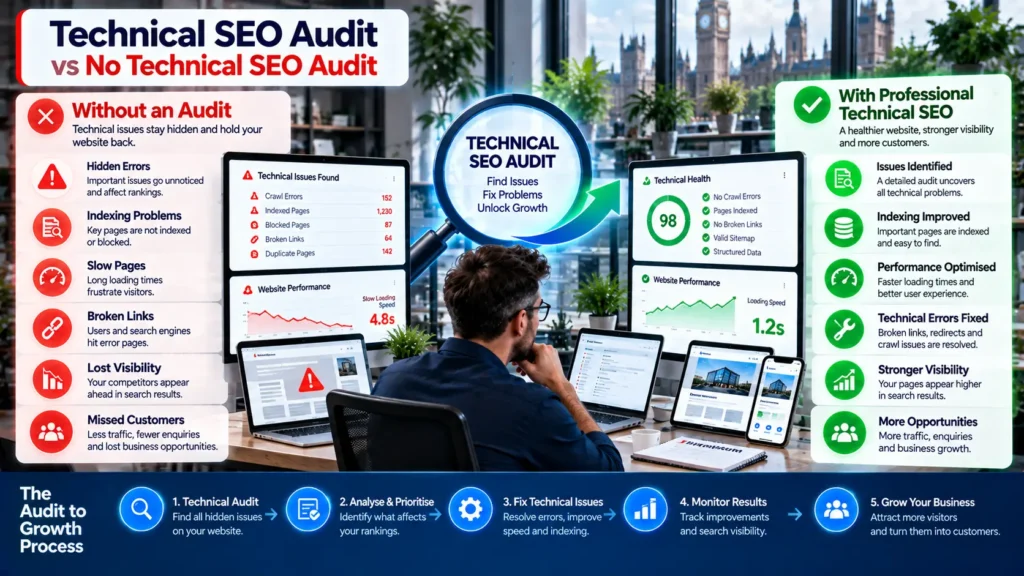
A technical SEO audit can examine:
- Crawl errors
- Blocked resources
- Robots.txt
- Internal links
- Sitemap files
- Redirect chains
- Orphan pages
- Server responses
The goal is to make important pages accessible.
Not every page on a website needs to be indexed.
A professional SEO strategy should help search engines focus on the pages that actually matter.
Indexing Problems Can Waste SEO Investment
Getting a page crawled does not automatically mean it will appear in search results.
Search engines also need to process and index the page.
Indexing problems can happen for several reasons.
Examples include:
- Noindex directives
- Incorrect canonical tags
- Duplicate pages
- Poor internal linking
- Server errors
- Low quality pages
- Incorrect redirects
- Technical conflicts
This is why checking indexing status is an important part of technical SEO.
You may be investing in content that search engines cannot properly use.
A technical audit can reveal whether important pages are actually available for search.
Website Architecture Should Make Sense
A good website architecture creates a clear relationship between pages.
For a service business this might look like:
Homepage
↓
Services
↓
Service Page
↓
Supporting Content
For ecommerce it could look like:
Homepage
↓
Category
↓
Subcategory
↓
Product
This structure helps users navigate the website.
It can also help search engines understand which pages are important.
A poorly organised website can make important pages difficult to discover.
Internal Linking Is a Technical Opportunity
Internal links connect pages within your website.
They can help visitors discover related content.
They can also help search engines understand relationships between pages.
For example a technical SEO article can link to a technical SEO service page.
A web development article can link to a web development service.
An ecommerce guide can connect to an ecommerce development service.
The links should be useful.
They should help users move naturally through the website.
Orphan Pages Can Be Difficult to Discover
An orphan page is a page that has few or no internal links pointing towards it.
The page may exist.
It may even contain valuable information.
But its connection to the rest of the website can be weak.
A technical SEO audit can identify orphan pages and determine whether they should:
- Receive internal links
- Be improved
- Be redirected
- Be removed
- Remain separate
This can help create a cleaner website structure.
XML Sitemaps Help Communicate Website Structure
An XML sitemap provides search engines with information about pages that a website considers important.
A technical SEO service can check whether your sitemap is:
- Available
- Current
- Valid
- Accessible
- Free from unnecessary URLs
A sitemap should not simply contain every URL on a website.
It should support the pages that you want search engines to discover and consider.
For larger websites this becomes especially important.
Robots.txt Needs Careful Management
Robots.txt can provide instructions about which areas of a website automated crawlers should access.
A small mistake can create a large problem.
Imagine blocking an important folder containing service pages.
Those pages may become difficult for search engines to crawl.
Technical SEO professionals therefore review robots.txt carefully.
The goal is to prevent unnecessary crawling while keeping important content accessible.
Canonical URLs Help Manage Duplicate Content
Websites can sometimes create multiple URLs that show similar or identical content.
This is common with ecommerce websites.
Products may appear through different filters.
Tracking parameters can create additional URLs.
Sorting options can generate different versions of the same page.
Canonical signals can help communicate which version should be treated as the preferred URL.
A technical SEO audit can identify canonical issues such as:
- Missing canonical tags
- Incorrect canonical targets
- Self canonical problems
- Canonicals pointing to redirects
- Conflicting signals
Correct implementation helps create a clearer URL structure.
Redirects Need a Clear Strategy
Websites change.
Pages are renamed.
Services are removed.
Websites are redesigned.
Domains can change.
Redirects help users and search engines move from an old URL to a relevant new destination.
Problems can arise when websites contain:
- Redirect chains
- Redirect loops
- Broken redirects
- Irrelevant redirects
- Large numbers of unnecessary redirects
A professional technical SEO service can audit redirects and improve the overall structure.
Page Speed and Core Web Vitals
Website performance affects the user experience.
Google’s Core Web Vitals include three important measurements.
Largest Contentful Paint
LCP measures loading performance.
Google’s recommended target is 2.5 seconds or less for a good experience.
Interaction to Next Paint
INP measures responsiveness.
A good target is below 200 milliseconds.
Cumulative Layout Shift
CLS measures visual stability.
A good target is below 0.1.
These measurements provide useful indicators of how visitors experience a website.
Improving performance can involve:
- Image optimisation
- Code optimisation
- Better caching
- Reduced unnecessary scripts
- Improved hosting
- Efficient page loading
- Better resource management
Technical SEO can identify performance problems and help prioritise improvements.
Mobile SEO Should Be Part of Technical SEO
Most modern websites need to work effectively on mobile devices.
A mobile visitor should be able to:
- Read content
- Navigate menus
- Click buttons
- Complete forms
- Browse services
- Purchase products
- Contact the business
Technical SEO can review mobile usability across important pages.
Problems such as tiny text difficult navigation oversized elements and poor page performance can create unnecessary friction.
HTTPS Is Essential for a Professional Website
Security is an important part of modern website infrastructure.
HTTPS encrypts communication between the visitor and the website.
It is especially important for businesses handling:
- Contact information
- Customer accounts
- Payment information
- Online transactions
- Forms
An ecommerce website should have security built into its development from the beginning.
Technical SEO audits can also identify security related configuration issues.
Structured Data Can Help Search Engines Understand Pages
Structured data provides additional information about the content of a page.
Depending on the website this may include information about:
- Products
- Businesses
- Articles
- Events
- Organisations
- Services
- Reviews
Correct structured data can help search engines understand the information presented on a page.
It must be accurate.
It should represent content that actually exists on the website.
Incorrect structured data can create confusion and may prevent eligibility for certain search features.
Technical SEO for Ecommerce Websites
Ecommerce websites often have more technical SEO challenges than smaller business websites.
A store can have hundreds or thousands of URLs.
Technical SEO may need to address:
- Product indexing
- Category structure
- Faceted navigation
- Product variants
- Duplicate URLs
- Canonicalisation
- Pagination
- Product structured data
- Internal linking
- Out of stock products
- Discontinued products
- Filters
- Search result pages
For an ecommerce business technical SEO can therefore have a direct connection with product visibility.
If important products cannot be properly discovered then the business can lose organic opportunities.
Technical SEO for Local Businesses
Local businesses also need technical SEO.
A local website should provide clear information about:
- Business services
- Service areas
- Contact details
- Opening hours
- Location
- Local pages
Technical optimisation can then support the wider local SEO strategy.
Important areas can include:
- Mobile performance
- Structured data
- Internal links
- Local landing pages
- Crawlability
- Indexing
- Page speed
Technical SEO and local SEO should work together.
Technical SEO for Large Websites
Large websites create different challenges.
A website with thousands of pages cannot always be managed in the same way as a small brochure website.
Crawl efficiency becomes more important.
Duplicate pages can increase.
Internal linking becomes harder to manage.
Old content can remain indexed.
Technical errors can multiply.
A technical SEO campaign for a large website may therefore include:
- Crawl analysis
- Log analysis
- Indexation analysis
- URL management
- Internal link analysis
- Redirect auditing
- Sitemap optimisation
- Duplicate content analysis
The larger the website the more important a structured technical process becomes.
Technical SEO Before a Website Redesign
A website redesign is an important moment for SEO.
Changing the design does not automatically mean rankings will remain stable.
A redesign can change:
- URLs
- Page structure
- Internal links
- Metadata
- Content
- Images
- Navigation
- Redirects
This is why technical SEO should be involved before the new website launches.
A pre launch audit can identify important pages that need to be preserved.
A migration plan can then reduce unnecessary disruption.
Technical SEO Audit vs Ongoing Technical SEO
Some businesses only order a technical audit.
Others need ongoing technical SEO.
| Technical SEO Audit | Ongoing Technical SEO |
|---|---|
| Snapshot of website health | Continuous monitoring |
| Identifies existing issues | Finds new issues |
| Useful for new projects | Useful for active websites |
| Prioritises fixes | Tracks implementation |
| Often project based | Ongoing service |
| Good starting point | Supports long term growth |
A technical audit can provide a roadmap.
Ongoing technical SEO helps make sure the website continues to perform as it changes.
What Does a Technical SEO Service Include?
A professional technical SEO service can include several stages.
Technical Website Audit
The website is crawled and analysed.
Indexing Review
Important pages are checked for search engine accessibility.
Crawlability Review
Potential crawl barriers are identified.
Site Architecture Analysis
The relationship between pages is examined.
Internal Link Analysis
Important pages and link gaps are identified.
Page Speed Review
Performance issues are investigated.
Mobile Review
Important pages are checked for mobile usability.
Canonical Audit
Canonical signals are reviewed.
Redirect Audit
Redirect chains and broken redirects are identified.
Sitemap Review
XML sitemap quality is assessed.
Structured Data Review
Schema implementation is checked.
Technical Recommendations
Issues are prioritised according to business impact.
Technical SEO Audit Checklist
A technical SEO audit should cover more than one or two basic checks.
| Technical Area | What to Review |
|---|---|
| Crawlability | Can important pages be crawled |
| Indexing | Are important pages indexed |
| Robots.txt | Are useful pages accessible |
| XML sitemap | Is the sitemap accurate |
| Canonicals | Are preferred URLs clear |
| Redirects | Are redirects working correctly |
| Internal links | Are important pages connected |
| Page speed | Are pages loading efficiently |
| Mobile | Does the site work well on mobile |
| HTTPS | Is the website secure |
| Structured data | Is markup accurate |
| Errors | Are broken pages being resolved |
| Architecture | Is the site logically organised |
This provides a stronger picture of technical website health.
Technical SEO Services vs DIY SEO
Business owners can perform some technical SEO tasks themselves.
The challenge is knowing which problems matter most.
| DIY SEO | Professional Technical SEO |
|---|---|
| Basic checks | Detailed technical audit |
| Limited crawling | Full website crawling |
| Manual inspection | Specialist analysis |
| Reactive fixes | Prioritised technical strategy |
| Less time available | Dedicated SEO resources |
| Limited technical expertise | Specialist technical knowledge |
| Basic reporting | Detailed technical reporting |
A professional service can be particularly valuable for ecommerce websites large websites and websites undergoing major changes.
What Results Can Technical SEO Support?
Technical SEO does not guarantee a particular ranking.
Search visibility depends on many factors.
Technical SEO can however improve the conditions that allow search engines to access understand and process your website.
Possible outcomes include:
- Better crawlability
- Cleaner indexing
- Stronger website architecture
- Improved page performance
- Better mobile experience
- Fewer technical errors
- Better internal linking
- Clearer page relationships
- Stronger SEO foundations
The commercial value comes when these improvements support important pages and valuable search opportunities.
How Technical SEO Can Support Revenue
Technical SEO can sit underneath the entire customer journey.
Consider this path:
Search
↓
Website
↓
Service Page
↓
Trust
↓
Enquiry
↓
Customer
If the website has technical problems at the beginning of this journey then later marketing work can become less effective.
For example a business may spend money creating content.
If important content cannot be indexed then the investment may not deliver its full potential.
A business may create a valuable service page.
If the page is buried deep within the website then customers may struggle to discover it.
Technical SEO helps strengthen the foundation.
How Much Do Technical SEO Services Cost?
There is no universal price for technical SEO.
The investment depends on the website and the complexity of the work.
Factors can include:
- Number of pages
- Website platform
- Ecommerce functionality
- Number of technical issues
- Website age
- Number of domains
- Migration requirements
- International targeting
- Content volume
- Development requirements
| Website Type | Technical SEO Complexity |
|---|---|
| Small business website | Low to moderate |
| Service website | Moderate |
| Ecommerce website | Moderate to high |
| Large business website | High |
| International website | High |
| Complex ecommerce platform | Very high |
A professional agency should explain what will be audited and which problems will be prioritised.
When Should You Hire a Technical SEO Agency?
Technical SEO support can be valuable when:
- Organic traffic has dropped
- Important pages are not indexed
- Google Search Console shows errors
- The website has become slow
- A website redesign is planned
- An ecommerce catalogue has grown
- The website has thousands of URLs
- Rankings have declined
- A migration is planned
- Search visibility has stopped growing
You do not always need to wait until something goes wrong.
Technical SEO can also be used as preventative maintenance.
Why Choose WebFox Agency for Technical SEO Services?
WebFox Agency provides SEO focused on the technical foundations that support search visibility.
Our approach can include:
- Technical SEO audits
- Crawl analysis
- Indexing reviews
- Website architecture analysis
- Internal linking reviews
- Page speed analysis
- Mobile optimisation
- Canonical audits
- Redirect audits
- Sitemap reviews
- Structured data checks
- Ecommerce technical SEO
- SEO migration support
- Ongoing technical monitoring
The focus is on finding problems and prioritising fixes according to their potential business impact.
A technical SEO audit should not leave you with a long list of confusing errors.
You should understand what the problem is.
You should understand why it matters.
You should know what needs to happen next.
Our Technical SEO Process
A structured process helps turn technical problems into practical improvements.
Step 1: Website Discovery
We review the website structure platform and business goals.
Step 2: Technical Crawl
The website is analysed for technical issues.
Step 3: Indexing Analysis
Important pages are checked for search accessibility.
Step 4: Architecture Review
The relationship between important pages is evaluated.
Step 5: Performance Review
Page experience and technical performance are assessed.
Step 6: Issue Prioritisation
Problems are organised according to importance.
Step 7: Recommendations
Clear actions are provided for each major issue.
Step 8: Implementation Support
Technical fixes can be supported through collaboration with your development team.
Step 9: Validation
Important fixes are checked after implementation.
Step 10: Ongoing Monitoring
The website can continue to be monitored as it grows and changes.
Frequently Asked Questions About Technical SEO Services
What Are Technical SEO Services?
Technical SEO services focus on improving the technical structure of a website so search engines can crawl understand and index important pages more effectively.
Why Is Technical SEO Important?
Technical SEO helps remove website issues that can make it harder for search engines to access important pages and understand the structure of your website.
What Does a Technical SEO Audit Check?
A technical audit can examine crawling indexing redirects internal links page performance mobile usability structured data canonical URLs XML sitemaps and other technical elements.
Can Technical SEO Improve Rankings?
Technical SEO can improve the foundations that support search visibility. It does not guarantee specific rankings because rankings depend on many factors.
How Often Should a Technical SEO Audit Be Done?
The ideal frequency depends on the size and complexity of the website. Large websites and ecommerce stores may benefit from regular technical monitoring.
Is Technical SEO Important for Ecommerce Websites?
Yes. Ecommerce websites often have large numbers of URLs and complex navigation. Technical SEO can help manage product indexing category structures duplicate pages and internal linking.
Can Technical SEO Help a Local Business?
Yes. Local businesses still need technically sound websites. Technical SEO can support local landing pages mobile performance structured data and search accessibility.
Does Technical SEO Improve Website Speed?
Technical SEO can identify performance problems and recommend improvements. Development work may then be required to implement some fixes.
What Are Core Web Vitals?
Core Web Vitals are measurements related to loading performance responsiveness and visual stability. They include LCP INP and CLS.
What Is an XML Sitemap?
An XML sitemap is a file that provides search engines with information about URLs that a website considers important for discovery.
What Is Canonicalisation?
Canonicalisation is the process of communicating which version of a URL should be treated as the preferred version when multiple similar URLs exist.
What Is Crawlability?
Crawlability refers to how easily search engine crawlers can access pages and resources on a website.
What Is Indexing?
Indexing is the process through which search engines process and store information about pages so they can potentially appear in search results.
Can Technical SEO Help After a Website Redesign?
Yes. Technical SEO can help identify important URLs and structural elements that should be preserved during a redesign or migration.
How Much Do Technical SEO Services Cost?
The cost depends on the website size platform complexity technical issues and scope of work. A small business website usually requires a different level of technical SEO support from a large ecommerce website.
Should I Hire a Technical SEO Services Company?
Professional support can be useful when your website has complex technical issues when organic visibility has declined or when your business is planning a redesign migration or major website expansion.
Get Professional Technical SEO Services From WebFox Agency
Your website is the foundation of your organic search strategy.
If that foundation has technical problems then publishing more content may not solve the real issue.
A professional technical SEO service can uncover the problems that are hidden beneath the surface.
It can identify indexing barriers.
It can improve website architecture.
It can uncover broken links.
It can highlight duplicate URLs.
It can identify performance problems.
It can improve internal linking.
It can make important pages easier to discover.
At WebFox Agency we focus on technical SEO that supports real business objectives.
We do not treat technical SEO as a list of complicated errors.
We turn technical findings into practical actions that can help strengthen your website.
If your organic visibility has declined or your website is struggling to gain traction then a technical SEO audit can show you what is happening beneath the surface.
Choose WebFox Agency for professional technical SEO services designed to strengthen your website and create a better foundation for organic growth.