
Your website should fit your business, not the other way around. If you have ever tried to force a growing business into a standard website template, you will know how quickly limitations appear. The design may look acceptable, but the navigation does not quite work, the customer journey feels awkward, important features are difficult to add and every new requirement seems to involve another plugin or workaround.
This is where bespoke website development can make a real difference.
A bespoke website is built around the way your business operates, the customers you want to reach and the goals you want the website to achieve. Rather than starting with a fixed template and adapting your business to it, the development process starts with your requirements. The result can be a website that is easier for customers to use, easier for your business to manage and better prepared for future growth.
For UK businesses that rely on their website for enquiries, bookings, sales or customer interaction, this can turn the website from a simple online presence into a genuine business asset.
What Is Bespoke Website Development?
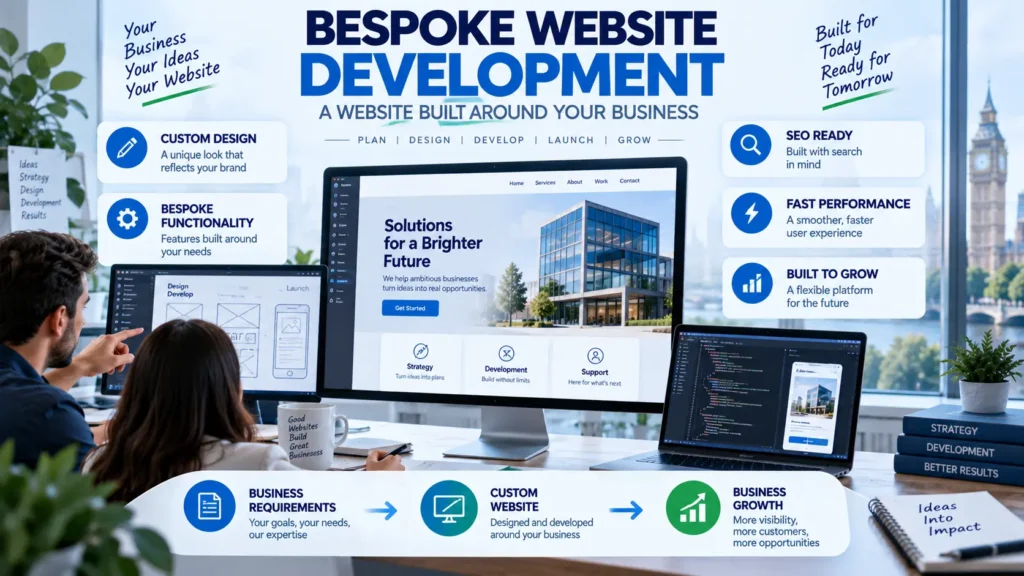
Bespoke website development is the process of creating a website specifically for a business rather than relying entirely on a pre-built website template.
The word “bespoke” does not necessarily mean that everything has to be coded from scratch. Modern development agencies use established platforms, frameworks and technologies where they make sense. What makes the project bespoke is that the structure, design, functionality and technical setup are created around the requirements of the business.
A professional services company may need a sophisticated enquiry process. An online retailer may need a particular product configuration system. A membership organisation might require customer accounts and personalised dashboards. A manufacturer could need its website to connect with internal systems or product databases.
These businesses do not necessarily need the same website.
That is why the first conversation with a good web development agency should be about the business rather than colours, templates or animations.
Why Are Businesses Choosing Bespoke Websites?
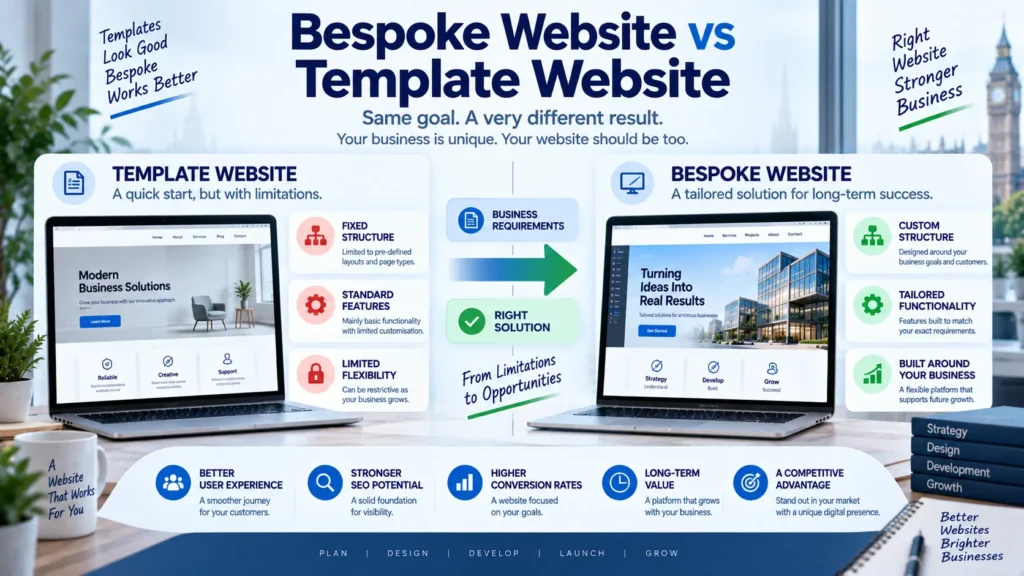
There is nothing inherently wrong with using a template. For a small company with straightforward requirements, a well-built template website can provide an affordable and practical starting point.
The problem comes when a business outgrows the structure.
A website that originally had five pages may eventually need twenty or thirty. A simple contact form may need to become a quotation system. A basic product catalogue may need advanced filtering. A company that once only generated enquiries online may later want online payments, customer accounts or CRM integration.
At that point, constantly modifying an existing website can become frustrating and expensive.
| WEBSITE REQUIREMENT | TEMPLATE APPROACH | BESPOKE APPROACH |
|---|---|---|
| Website structure | Pre-defined layouts | Built around business requirements |
| Visual experience | Adapted from existing designs | Designed specifically for the brand |
| Functionality | Mainly standard features | Custom functionality available |
| Integrations | Dependent on available tools | Can be developed around required systems |
| Customer journey | Adapted to the template | Designed around the target audience |
| SEO structure | Depends on platform and setup | Planned during development |
| Future growth | May become restrictive | Can be designed for expansion |
The important point is not that bespoke development is always better. It is that the right approach depends on what the business actually needs.
When Does a Business Need a Bespoke Website?
There is usually a point when a standard website stops being convenient and starts becoming a restriction.
You may notice that your website cannot accommodate the customer journey you want. Perhaps customers need to complete several steps before making an enquiry, or perhaps your sales team needs information from the website to flow into another system.
Sometimes the issue is much simpler. Your website may look dated, work poorly on mobile devices or be difficult to update. In other cases, the technology underneath the website may have become outdated.
A useful question to ask is whether your current website can realistically support the business you want to operate over the next three to five years.
If the answer is no, it may be worth discussing a bespoke development project with a professional web agency.
What Goes Into a Bespoke Website?
A successful bespoke website is not created simply by handing a design to a developer.
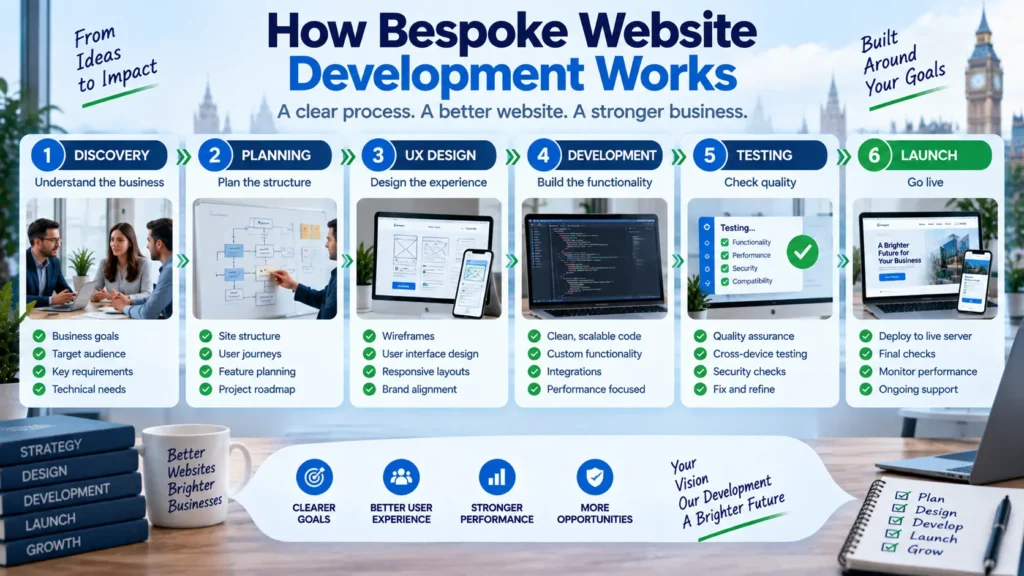
The process normally begins with understanding the business, its audience and the purpose of the website. From there, the structure and customer journey can be planned before the visual design is produced.
Development then turns that design into a functioning website, while technical SEO, performance, security and usability need to be considered throughout the project.
| STAGE | PURPOSE |
|---|---|
| Discovery | Understand the business and its objectives |
| Planning | Establish the website structure and requirements |
| UX | Plan how visitors will navigate and interact |
| Design | Create the visual experience |
| Development | Build the functionality |
| SEO | Establish a search-friendly technical foundation |
| Testing | Check usability, performance and functionality |
| Launch | Make the website live |
| Support | Maintain and improve the website over time |
This process is important because problems discovered during planning are generally easier to solve than problems discovered after launch.
Why Should UX Be Considered Before Development?
A website can look excellent and still be difficult to use.
Think about a potential customer arriving on your website for the first time. They may want to understand what you offer, decide whether they trust you and then contact you. If finding the relevant information takes too long, there is a good chance they will leave.
Bespoke development gives you the opportunity to design the customer journey around the actual behaviour of your audience.
A B2B business might need visitors to move from services to case studies, then to an enquiry form. An eCommerce company might need customers to compare products before purchasing. A booking-based business may need visitors to select a service, choose a date and complete a booking.
These are very different experiences.
The website should be developed around the journey rather than forcing every business into the same structure.
Can Bespoke Website Development Help SEO?
Bespoke development does not automatically make a website rank higher in Google. Search visibility depends on many factors, including content, relevance, technical quality, competition, authority and the quality of the overall website experience.
However, developing a website with SEO in mind from the beginning can create a much stronger foundation.
The website architecture can be planned around important services and search intent. Page URLs, headings, internal links, metadata, mobile usability and technical performance can all be considered during development instead of being treated as problems to fix later.
This is particularly useful for businesses that intend to invest in ongoing SEO.
For example, a company targeting several services across different UK locations may need a website structure that supports service pages and genuine location-based content. Building that structure into the website from the beginning is generally more practical than trying to retrofit it later.
Bespoke Websites and Local SEO
For many UK businesses, location is an important part of the buying decision.
A customer searching for an accountant, builder, solicitor, web agency or other professional service may include a town or city in their search, or use phrases such as “near me”.
A well-planned website can help communicate where a business operates and which services it provides.
For example, a company serving Birmingham, Manchester and Leeds might require carefully planned service and location pages. Those pages should provide genuinely useful information rather than simply repeating the same content with different city names.
This is where SEO and GEO-focused website development work together. Search engines need to understand what the business does, who it serves and where it operates. Customers need the same information in a clear and natural way.
How Much Does Bespoke Website Development Cost?
The cost of a bespoke website varies considerably.
A relatively simple business website with a tailored design is very different from a platform requiring customer accounts, payments, API integrations, advanced search, booking functionality or a custom database.
This is why comparing web agencies based only on the headline price can be misleading.
| PROJECT FACTOR | LOWER COMPLEXITY | HIGHER COMPLEXITY |
|---|---|---|
| Website size | Smaller website | Larger website structure |
| Design | Straightforward custom design | Detailed bespoke UX/UI |
| Functionality | Standard forms | Complex business processes |
| Integrations | Few or none | CRM, APIs or other systems |
| Accounts | Not required | Customer or member accounts |
| eCommerce | Basic catalogue | Advanced purchasing functionality |
| SEO | Technical foundations | Full SEO strategy |
| Support | Occasional maintenance | Continuous development |
A professional agency should be able to explain what is included in its quotation and why the proposed solution is appropriate.
If two agencies give you dramatically different prices, look carefully at the scope before assuming that one is simply cheaper.
How Should You Evaluate a Bespoke Website Investment?
Price is important, but it should not be the only measure.
One useful way of looking at a website project is to consider where the development effort is being directed. The following is an illustrative framework rather than an industry-standard allocation.
| AREA | SUGGESTED FOCUS |
|---|---|
| Business requirements | 15% |
| User experience | 15% |
| Bespoke design | 15% |
| Development and functionality | 20% |
| SEO foundations | 10% |
| Performance and technical quality | 10% |
| Testing and launch | 5% |
| Support and future improvements | 10% |
| TOTAL | 100% |
The figures are not intended to tell every business exactly how its budget should be divided. They simply demonstrate that successful website development involves considerably more than writing code.
A website can have excellent development behind it and still fail to generate enquiries if the customer journey is confusing or the content does not explain the service properly.
Does a Bespoke Website Improve Website Performance?
It can, provided performance is considered during development.
Some websites become slow because they contain unnecessary plugins, excessive scripts, oversized images or poorly implemented functionality. Adding more features without considering performance can eventually create a poor user experience.
A bespoke development project gives the developer greater control over how the website is structured and how functionality is implemented.
Performance considerations can include image optimisation, efficient code, mobile performance, caching, hosting, scripts and page structure.
Speed should not be treated as an afterthought. Building a technically sound website from the beginning is generally preferable to trying to repair a poorly structured website later.
Bespoke Development or Website Redesign?
Not every business that has an outdated website needs a completely new platform.
Sometimes a design refresh is enough. In other cases, the existing technology may still be suitable but the navigation, content or performance needs attention.
| CURRENT SITUATION | MORE APPROPRIATE DIRECTION |
|---|---|
| Website looks dated | Design refresh |
| Navigation is difficult | UX improvement |
| Pages load slowly | Performance optimisation |
| Content is outdated | Content improvement |
| Website has limited functionality | Bespoke development |
| Technology is restrictive | Redevelopment |
| Several structural problems exist | Bespoke redesign |
| Business requires unique systems | Custom development |
A good web agency should be willing to recommend improvements when a full rebuild is unnecessary.
That is an important part of choosing the right development partner. You are paying for expertise, not simply for someone to sell you the largest possible project.
What Should You Look for in a Bespoke Web Development Agency?
Choosing a development agency is an important decision because the relationship does not necessarily end when the website launches.
You should be comfortable with the agency’s approach to communication, planning, design, development and support.
Experience is useful, but relevant experience is even more valuable. An agency that understands your type of business or has delivered similar functionality may be better positioned to understand your requirements.
You should also ask how SEO will be handled, who owns the website and its assets, how future changes will be managed and what support will be available after launch.
The technology should also have a clear purpose. An agency should be able to explain why a particular platform or development approach has been selected rather than simply choosing whatever technology it uses for every project.
Comparing Bespoke Web Development Agencies
When you receive several proposals, avoid comparing only the final price.
Look at what each agency has understood about your business and whether its proposal actually addresses your requirements.
| AREA TO COMPARE | QUESTION TO ASK |
|---|---|
| Strategy | Does the agency understand what the website needs to achieve? |
| UX | Has the customer journey been properly considered? |
| Design | Is the design genuinely tailored to your business? |
| Development | Can the agency deliver the functionality you need? |
| SEO | Are SEO requirements included from the beginning? |
| Performance | How will website speed be handled? |
| Ownership | Who owns the website and digital assets? |
| Support | What happens after launch? |
| Scalability | Can the website evolve as the business grows? |
The best proposal is usually the one that provides the clearest connection between your business requirements and the proposed website.
Why Choose WebFox Agency for Bespoke Website Development?
WebFox Agency provides web design, web development, eCommerce and SEO solutions for UK businesses that want their website to do more than simply provide basic information.
A bespoke website can bring these areas together. The design can reflect the brand, the development can provide the required functionality and the SEO structure can be considered as part of the build.
For a growing business, this integrated approach can be particularly useful because the website becomes part of the wider digital strategy rather than an isolated project.
Whether the requirement is a business website, eCommerce platform, WordPress development, custom functionality, booking system, website redesign or ongoing optimisation, the starting point should always be the same: understanding what the business and its customers actually need.
The aim is not to build a complicated website simply because it is possible. The aim is to build the right website for the business.
What Is the Long-Term Value of a Bespoke Website?
The biggest advantage of bespoke development is flexibility.
As your business changes, your website may need to change with it. You might introduce a new service, expand into another location, add online sales, connect a CRM, create customer accounts or introduce a new way for customers to interact with your business.
A website built around your requirements gives you more control over those changes.
That does not mean a bespoke website will never require redevelopment. Technology changes, customer expectations change and businesses evolve. But a well-planned platform can provide a stronger foundation for those changes.
For a business that sees its website as an important part of sales, marketing or operations, that flexibility can be worth considerably more than the initial difference between a template and bespoke solution.
Frequently Asked Questions
What is bespoke website development?
Bespoke website development involves creating a website around the specific requirements of a business, including its branding, customer journey, functionality, SEO structure and future objectives.
How much does bespoke website development cost in the UK?
There is no standard price. The cost depends on the size of the website, design requirements, functionality, integrations, eCommerce features, SEO requirements and ongoing support. A detailed project specification is normally required before an accurate quotation can be provided.
Is a bespoke website better than a template website?
Not necessarily for every business. A template can be perfectly suitable for a company with straightforward requirements. Bespoke development becomes more valuable when a business needs unique functionality, specific customer journeys, integrations or greater control over the website.
Can a bespoke website be built using WordPress?
Yes. WordPress can be used to create highly customised websites when it is configured and developed appropriately. The platform can be adapted to suit the requirements of the business rather than relying solely on pre-built themes.
Is bespoke website development good for SEO?
Bespoke development does not guarantee higher rankings, but it allows SEO requirements to be considered during the planning and development process. Website structure, URLs, internal linking, mobile usability and technical performance can all be incorporated into the build.
How long does a bespoke website take to develop?
The timeframe depends on the complexity of the project. A relatively straightforward business website will generally require less development work than a website involving custom databases, eCommerce functionality, customer accounts or multiple integrations.
Can a bespoke website integrate with a CRM?
Yes. Where the relevant systems provide suitable integration options, a custom website can be developed to communicate with CRM platforms and other business software.
Should I redesign my existing website or build a new one?
It depends on the condition of the existing website. If the technology is sound, improvements may be sufficient. If the website has outdated technology, poor architecture, serious performance issues or cannot support required functionality, redevelopment may be the better option.
Who owns a bespoke website?
Ownership depends on the agreement between the client and development agency. Before starting the project, you should clarify ownership of the domain, website, code, content, designs and other digital assets.
Is bespoke web development suitable for small businesses?
Yes, provided the business has a genuine need for a tailored solution. A small business does not necessarily need a complex website, but bespoke development can be valuable when its requirements cannot be handled effectively by a standard website.
Can WebFox Agency develop a bespoke website?
WebFox Agency provides web development and digital solutions for businesses requiring tailored websites, eCommerce development, redesigns, custom functionality, SEO and ongoing website support.
Final Thoughts
The decision to invest in bespoke website development should not be based on the idea that custom is automatically better.
It should be based on whether your website needs to perform a specific job that a standard solution cannot handle effectively.
If your business has outgrown its current website, needs unique functionality, wants greater control over the customer journey or is planning significant growth, a bespoke website can provide the flexibility required to move forward.
The best development projects begin with the business, not the technology. Once the objectives and customer requirements are clear, the right design, functionality and technical solution can follow.
For a growing UK business, that approach can produce something far more valuable than another attractive website: a digital platform built to support the way the business actually works.